Oct 01 2026
What Flexibility Looks Like
IntroductionThe best systems are able to adapt to different, new scenarios, and they handle them with grace. They gracefully survive new load, gracefully save compute, gracefully scale.
We know these graceful properties well because we even gave them names like serverless, scale-to-zero, separation of compute & storage.
But it gets complicated to talk about these ideas. Just the other month, we were riffing computers over dinner, when I heard the question "well what does serverless mean to you?"
The retort was a description of separation of compute & storage!
We often bend ourselves out of shape to force terms in conversation, but in turn, actively harm each other's mental models. This hallucination is typically exacerbated when we are pressured by hype.
But what's the worst thing those participants did? Should they suffer for simply being on the internet wanting to learn about these concepts?
This is often the case with techno-marketing, which is unfortunate because most of the congitive burden is on the consumer. Businesses, however, distances themselves from the fuss; plus, they benefit from it. It's madness.
My vendetta with these terms is that they describe the same quality. They are interlinked. It is poor thinking to describe Term A by Term B when both terms are aspirationally trajecting towards Flexibility.
Caveman EconomicsOne way to cut through the noise is to lay down how these systems make money anyway.
A perspective that makes flexibility interesting is that it impacts everyone involved. Even if you are the type of person whose experience in buying software is only what happens at checkout, the serverless/scale-to-zero/separation-of-compute-&-storage quality is still affecting you. Even if you do not know what it means, it affects your invoice in addition to it affecting the vendors.
Everything with a dollar sign has something else attached to it than just the face value of the dollar. It can be useful to have a core mental model of what makes serverless attractive in the economic sense. Here, we offer a caveman explanation.
In a serverless environment, a buyer can pay based on usage.
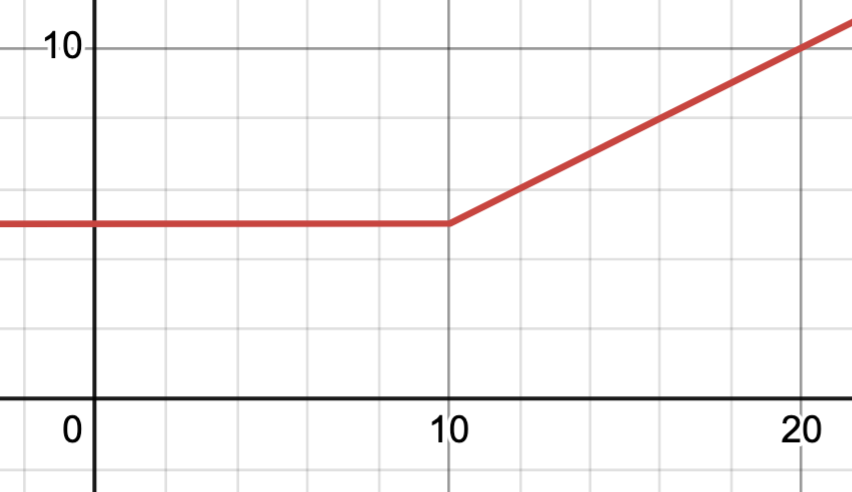
In practice, the usage-based model is typically attached with a base fee. Generally described by f(x) in Fig 1. This is a common approached used by serverless business models.
The handshake makes sense for both parties. The buyer acknowledges that their invoice is ruled by the rate of their usage and respects that a minimum fee must be involved. The seller is in the business of making a healthy business, so they are happy that their money flow $ is at least the fixed rate.
When we say the buyer is paying by usage, we mean that somewhere in the seller's architecture, there are provisioned resources to service the buyer. When the buyer stops using the service, the infrastructure gracefully turns off. It's demand-aware.
The seller is then incentivized to make their system more performant and more flexible. If they can reduce the cost of infrastructure, there is more room left for earnings.
Price of markup - cost of infra = earnings
The seller is now on a path of performance. By making the system better, they reduce the cost of infrastructure and it also means the buyer is now getting a better usage rate. This is good for the seller. It means they control the destiny of the earnings.
But it can be dangerous for the buyer. If the sellers are ill-intentioned, they can do whatever they want to the markup and they can do it for literally any reason. If they are pressured to report a higher projected earnings, they can. They can even do it out of ego.
The more elegant solution for the seller is that in recognition of improved infra costs, they can reduce the b term in f(x) = max(b, mx).
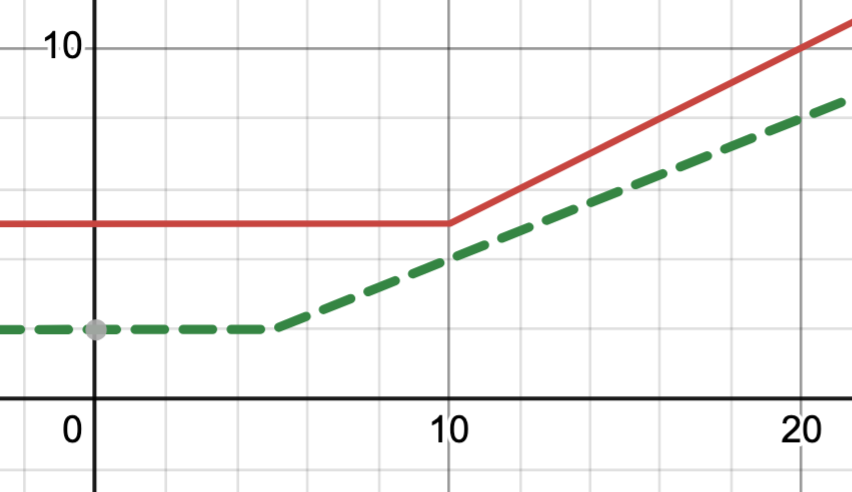
This is better for growth and the buyer is enabled to do more with the product.
There is risk involved. In the short term, it damages their revenue graph. For the seller, this can be scary until they make it back up with growth.
This makes the model sufficiently effective, but only if the seller is disciplined. This is a tricky feedback loop.
Musical Chairs and GymnasticsLet's walk through an example: buyer uses the service on their end of the screen, which automatically provisions the seller's computers. When the buyer doesn't need the computer, the computer turns off (or it serves someone else). Either way, the buyer stopped using the computer, so they no longer pay for it. That's pay for usage.
This describes scale-to-zero. Based on demand, turn off or provision more computers.
This is how serverless got derived. The buyer does not have to think about the computer(s). They are performing actions in a way that feels like the computers are not involved, or rather, it's the seller that is managing them.
This is why separating compute and storage is relevant because the seller is able to provision as many compute nodes as possible. They can shift from 0 to N computers however they want because the computers have no state. Since they can operate without state, they can also crash and no data is ever lost. This is a flexible quality. The property that we like about scale-to-zero is related to scaling-to-N.
Disaggregated compute & storage is also what enabled BYOC (bring your own cloud).
The terms are all interlinked. Why these terms show up in conversation is because only in the last few years has the ecosystem been able to build the true expression of qualities.
We saw these qualities in the horizon, so we gave them names, but were only able to capture a portion of their characteristics. But the modern belief is that all the substrates are now in the air.
The best systems do not get pigeonholed into one workload, they evolve into new ones. The best systems do not get left behind as soon as new environments get introduced, they age well and tame them with grace.
Today's next new workload is the agentic one, and it's moving rather quickly.